
Sources for Previous Residents of Azusa
Each source covers a different time layer. The table puts the deed chain, parcel key, household record, and local story beside one another so the previous residents trail does not confuse ownership with occupancy.
| Source | Years it covers | Where held | What it shows |
|---|---|---|---|
| Recorded instruments | 1851-present | Los Angeles County RR/CC | Grantor, grantee, instrument, legal description |
| Assessor parcel | Current and public history varies | Los Angeles County Assessor | AIN, situs, map, property characteristics |
| Federal census | 1850-1950 public schedules | NARA, libraries, partner sites | Household, relationships, birthplace, occupation |
| Azusa city and reverse directories | Exact local runs unverified | Azusa City Library and regional shelves | Past names, address, occupation, household clues |
| Azusa Herald | Collection coverage to verify | Azusa City Library digital archive | Obituaries, notices, clubs, school, property context |
| Permits and Sanborn maps | Portal or edition coverage varies | City of Azusa and LOC or library | Construction, use, footprint, project clues |
The exact Azusa directory publisher and year inventory remains a documented research gap. Ask the library before citing a volume that has not been verified.
Azusa Previous Residents and the AIN
Resolve the current address through the Los Angeles County Assessor Portal or its parcel map. Save the AIN, situs, map reference, use code, characteristics, and any legal-description clue. The AIN is the bridge from today’s postal text to older documents. It is not a list of residents and it does not by itself prove who occupied the property.
Write the address in every form found: directional prefix, street suffix, unit, cross street, tract, and old spelling. A mailing address can differ from situs. A tax record can identify a taxpayer or billing destination, while the legal description identifies the land. Those distinctions matter before earlier deeds or directories are read as belonging to the same house.
- AIN
- Assessor Identification Number, a county parcel key.
- Legal description
- Deed language that identifies the parcel through a lot, tract, map, or related land description.
- Chain of title
- A sequence of recorded transfers used to trace ownership backward.
- Occupancy clue
- A dated directory, census, newspaper, permit, or probate reference that may place a person at the property.
Azusa Deeds for Previous Residents
Los Angeles County’s recorder index is not searchable on the open Internet, by address, or by AIN. It is alphabetical by party name and year, with grantor and grantee roles. Take the likely current owner or transfer party, an approximate year, and the parcel legal description to the RR/CC index at 12400 Imperial Highway in Norwalk. Telephone index searches are not accepted.
When the entry is found, note the document number, title, recording date, grantor, grantee, year, page count, legal description, and image or copy route. The office reviews 1851-1957 on the lower level and 1958-present on the second floor. After the document is identified, complete copies can be ordered through the recorder’s online, mail, fax, or in-person channels. Do not start with a copy request that lacks a document number or party and year.
The RR/CC recorder page is the official access source.
The captured recorder access screen shows why an address must first become a party-and-year clue.
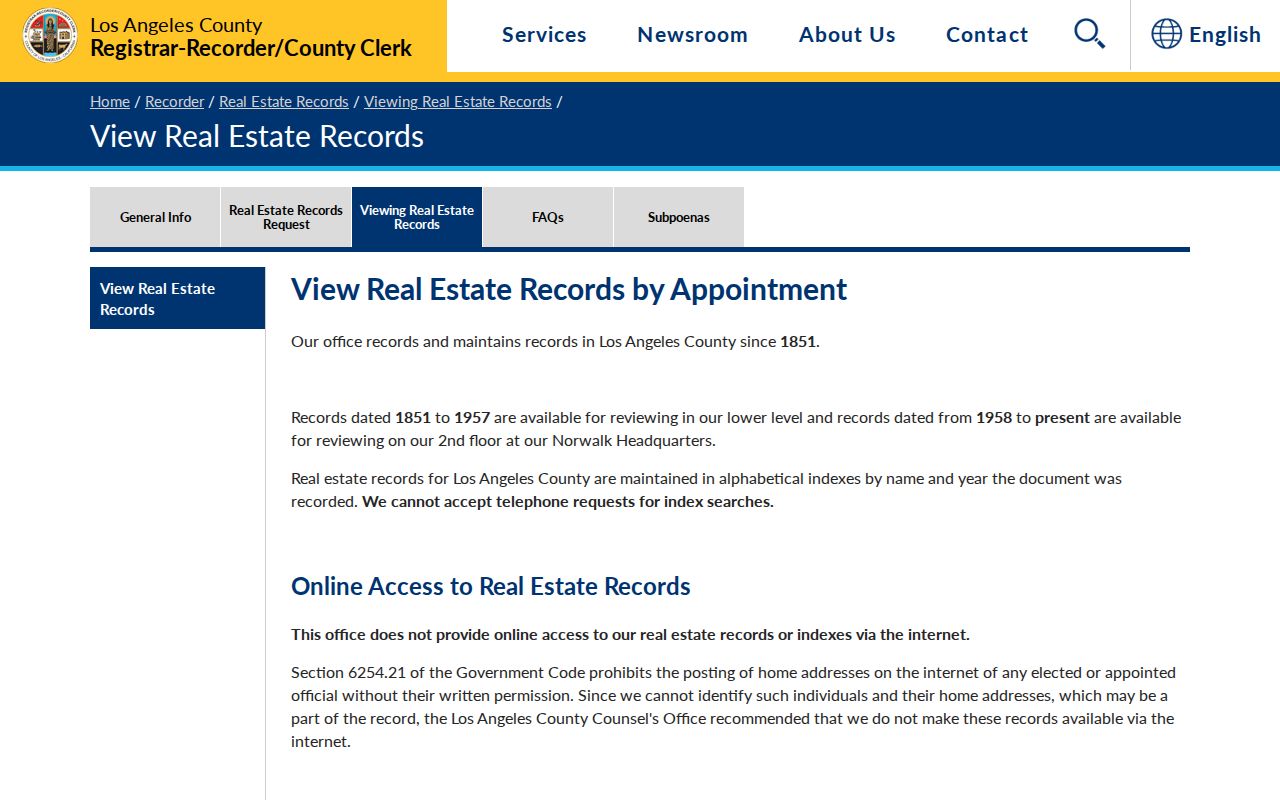
The image belongs beside the deed workflow, where the offline index is the key local fact.
Search Azusa Previous Residents Backward
The first deed is only the start of the previous residents trail. Treat the seller as an earlier buyer and search that party in a prior year. Compare the legal description and instrument type to reject same-name transactions. Repeat the chain toward 1851 as the question requires. Deeds, deeds of trust, liens, releases, plats, and other recorded instruments may explain a transfer, but a recorded party is not automatically an occupant.
- Resolve the current AIN and legal description.
- Find the recent acquisition deed at Norwalk and record both parties.
- Search the seller as an earlier grantee with an approximate year.
- Compare the legal description, document title, and parcel continuity.
- Save document numbers before ordering copies or moving to the next seller.
If the chain breaks, use an existing deed, tax document, probate file, permit, newspaper, or CPRA request to identify the next likely party. The recorder cannot supply the missing name by address.
A practical research day can pair the Los Angeles County Library Californiana Collection at 12350 Imperial Highway with the nearby RR/CC name-and-year indexes. Prepare spelling variants, approximate years, AINs, legal descriptions, and a note sheet before the visit. Save document numbers and titles, because those identifiers make later online, mail, fax, or in-person copy orders possible. A deed chain can establish title continuity, but census, directory, permit, Herald, obituary, or probate material is still needed to place people at the address.
Separate Azusa Owners from Previous Residents
Previous residents and past owners overlap, but they are not the same group. A deed records a legal transfer. A city directory or census can place a household at an address. A tax bill can show billing evidence. A permit can name an applicant or contractor. A newspaper can report a family event. Each record needs a label before it is added to a house history.
The Azusa city directory collections route covers how to read an alphabetical or reverse entry. Here, use the collection as one date layer in the address trail. Note whether the entry gives an occupant, owner or renter mark, spouse, occupation, business address, or removal note. Do not turn a missing entry into proof that no one lived there.
Print access at Azusa City Library is limited during the 2025-26 modernization, but reference help continues in person, by phone, and virtually. Ask staff to check unlisted directories, telephone books, obituary clippings, and local files before abandoning a past-household lead.
Ownership evidence is strongest when the legal description persists. Occupancy evidence is strongest when a dated household source agrees with another dated source.
Add Azusa Census to Previous Residents
Federal census schedules are the main household bridge through 1950. They can show names, relationships, birthplace, occupation, and an address or locality, depending on the schedule. Pair each census year with the nearest verified city directory issue. The directory can fill a gap between census snapshots, while the census can show children, relatives, or lodgers absent from a householder entry.
The 1890 population schedules were largely destroyed, so the 1880-1900 bridge needs other evidence. Deeds, tax material, voter history where lawful, newspapers, school records, naturalization, church or cemetery sources, and local manuscripts may help. The 1868 local census of children recorded in Henry Dalton’s diary is an unusual Azusa-area clue, though it is not a substitute for a federal schedule.
Record the census page, household order, locality, and source image. A name alone is not enough to attach a household to a parcel.
Date an Azusa House for Previous Residents
Permits and Sanborn maps can explain a building around the names. Azusa’s permit portal accepts Permit Number, Owner or Applicant, Address Number, and Street Name beginning. A permit can show a project, status, applicant, contractor, year built, accessory structure, or case date. The Real Property Records Report form can contain unit or occupant count and inspection details, but it is compliance evidence, not a list of all residents.
Sanborn maps may show footprint, material, use, and nearby features. The exact Azusa editions were not located in the official sweep, so confirm the map date through the Library of Congress catalog or a library database. Pair the sheet with the AIN, legal description, permit, or newspaper. A building footprint can support continuity without naming a household.
Use the Azusa permit portal and the Library of Congress Sanborn search guide as separate source paths.
Azusa Previous Residents: Obituaries and Households
Directories and census schedules show a household layer, while obituaries and probate can close a past-household trail. The Azusa Herald archive may carry obituary, legal, school, club, or family notices. A probate case can identify a decedent, petitioner, heirs, notices, and addresses in the public parts of the file. Confirm the newspaper relationship with a court, vital, census, or directory record before treating it as the final household link.
Funeral-home pages and cemetery memorial databases are leads, not the final custodian record. Modern death and marriage certificates have their own eligibility rules. If a court or vital record is sealed or confidential, ask the clerk, county, or CDPH about the authorized route. Do not use an obituary to infer a living person’s current address.
Probate plus obituary evidence is especially useful for an heir search, estate history, or a family project that needs to explain why ownership changed.
Bridge Azusa Addresses for Previous Residents
The research did not locate an authoritative Azusa street-renumbering chronology. When an old address fails, compare the AIN, tract or subdivision, map, legal description, deed, permit, council record, Sanborn sheet, and Herald notice. Keep the old spelling and modern form side by side. A parcel key can survive a street-name change that breaks a text search.
House-history limit. Previous-resident research is for lawful family history, property history, estate work, and personal curiosity. It does not authorize tracking, threatening, or harassing a living person.
If the parcel split, record the old and new AINs before linking a later deed or permit. If the parcel is unchanged, use the legal description to connect the historical household. The final result should say what the record proves, what it suggests, and what remains unknown.